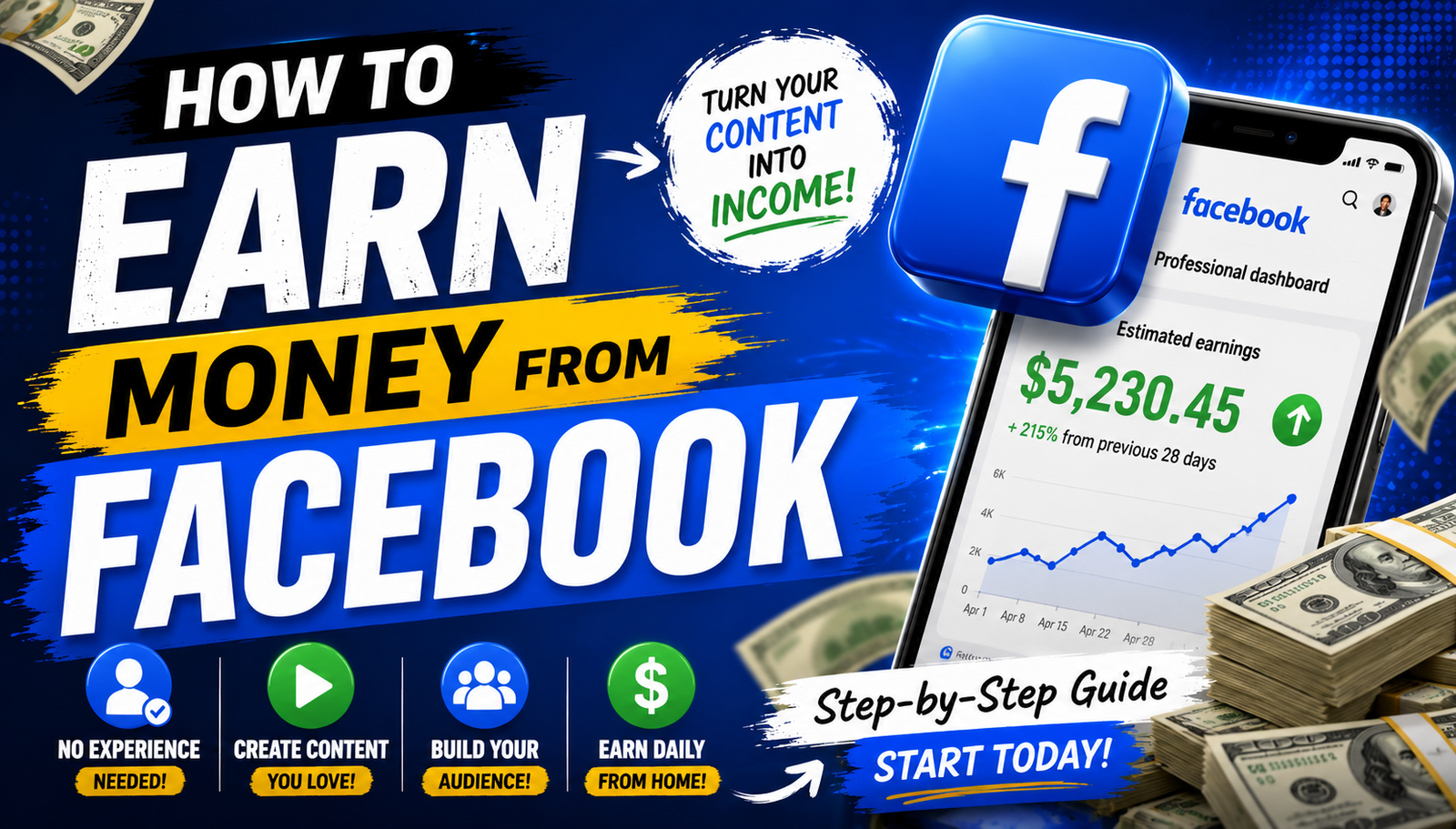
How to Earn From Facebook: A Complete Guide to Making Money on the Platform in 2026
Facebook is often overlooked in conversations about creator income, overshadowed by flashier platforms like TikTok and Instagram. But with nearly 3 billion monthly active users, Facebook remains one of the largest audiences on the internet — and one of the most underrated ways to build a genuine income. From video monetization and marketplace sales to group-based businesses and affiliate marketing, Facebook offers a surprising number of legitimate paths to earning money.
This guide breaks down every practical way to earn from Facebook, what’s required to get started, realistic income expectations, and the mistakes that hold most people back.
Why Facebook Still Matters for Earning Money
Facebook’s biggest advantage is reach combined with intent. Unlike some platforms where users are purely there for entertainment, Facebook users actively use the platform to research products, join communities, follow local businesses, and buy and sell items. That mix of scale and commercial intent makes it a genuinely useful platform for monetization — not just for personal brands, but for local businesses, e-commerce sellers, and content creators alike.
Facebook has also invested heavily in creator monetization tools over the past few years, meaning there are now several official, on-platform ways to earn — not just indirect ones.
Method 1: Facebook In-Stream Ads
If you post video content, In-Stream Ads let you earn a share of ad revenue from ads that play during your videos — similar to YouTube’s monetization model. Facebook inserts short ads before, during, or after your video, and you earn a percentage of the revenue generated.
To qualify, you typically need:
- At least 10,000 followers on your Page
- 600,000 total minutes viewed in the last 60 days
- At least 5 active videos on your Page
- Compliance with Facebook’s Partner Monetization Policies and Community Standards
Longer videos (three minutes or more) tend to perform better for this program since they allow for multiple ad breaks. Consistency matters here too — creators who post several videos a week tend to build watch-time numbers far faster than those posting occasionally.
Method 2: Facebook Reels Monetization
Short-form video hasn’t been left out either. Facebook Reels has its own monetization tools, including performance-based bonuses for creators whose Reels get strong engagement, plus ad breaks that can appear within Reels content. Eligibility and payout structures vary by region and account performance, so it’s worth checking your Page’s Professional Dashboard regularly, since Facebook periodically rolls out new monetization opportunities there.
Reels also serve a secondary purpose: they tend to get pushed to non-followers more than regular posts, making them a strong tool for growing your audience even if direct Reels payouts are modest.
Method 3: Facebook Stars
Stars are a virtual gifting feature that lets fans support creators during live videos or on posts. Viewers purchase Stars and send them to creators they want to support, and creators convert accumulated Stars into real payouts.
This works especially well for:
- Creators who go live regularly (Q&As, tutorials, cooking streams, gaming)
- Niche communities where followers feel personally invested in the creator’s content
- Creators who actively engage with commenters and gift-senders during live sessions, since recognition on stream tends to encourage more support
Like TikTok’s live gifting, this isn’t usually a primary income source on its own, but it adds up nicely alongside other monetization methods, especially for creators with a loyal, engaged following.
Method 4: Facebook Marketplace
Marketplace is one of the simplest and most direct ways to earn money on Facebook — no follower count or monetization approval required. It functions as a hyper-local classifieds section built directly into the platform, and it’s used by millions of people to buy and sell everything from furniture to electronics to clothing.
To succeed on Marketplace:
- Take clear, well-lit photos. Listings with quality images get significantly more clicks than blurry or poorly framed ones.
- Write honest, detailed descriptions. Include dimensions, condition, and any flaws upfront to avoid wasted back-and-forth with buyers.
- Price competitively. Check what similar items are selling for in your area before listing.
- Respond quickly. Buyers on Marketplace often message multiple sellers at once; fast responses win more sales.
- Consider reselling. Some sellers build a steady income by sourcing discounted or secondhand items — from thrift stores, clearance sales, or bulk lots — and reselling them at a markup on Marketplace.
For small business owners, Marketplace also functions as an extra sales channel alongside a dedicated online store, often at zero additional advertising cost.
Method 5: Selling Through a Facebook Shop
For businesses and creators selling products, Facebook Shops lets you set up a fully featured storefront directly on your Page. Customers can browse your catalog, view product details, and in many cases checkout without ever leaving Facebook.
This is particularly effective when combined with:
- Facebook Groups, where you can build a community around your niche and naturally introduce products
- Facebook Ads, which let you target very specific audiences based on interests, behavior, and demographics
- Instagram Shopping integration, since Facebook Shops can sync with Instagram, letting you manage both storefronts from one place
Facebook Shops works well for physical products, but also for digital products and services when linked out to an external checkout page.
Method 6: Affiliate Marketing
Facebook doesn’t have a built-in affiliate program the way TikTok Shop does, but it’s an extremely effective platform for driving affiliate sales through content and community.
Common approaches include:
- Sharing product recommendations and affiliate links in niche Facebook Groups (while following group rules on self-promotion)
- Posting review or tutorial-style videos that naturally incorporate affiliate links in the caption or comments
- Running a Page dedicated to a specific niche — deals, home improvement, parenting products, tech gadgets — and consistently sharing relevant affiliate offers
- Using Facebook Ads to promote high-converting affiliate offers directly (while complying with the advertiser’s affiliate terms and Facebook’s ad policies)
The creators who do well with affiliate marketing on Facebook tend to build trust first, sharing genuinely useful content and only recommending products they’d actually vouch for, rather than posting link after link with no context.
Method 7: Facebook Groups as a Business Model
Groups are one of Facebook’s most powerful, underrated monetization tools. A well-run, engaged Group can become the foundation of an entire business.
Ways to monetize a Group include:
- Paid membership Groups, where members pay a recurring fee for access to exclusive content, coaching, or community support
- Selling your own products or services to a highly engaged, trust-based audience
- Sponsored content or partnerships, where brands pay to reach your Group’s specific niche audience
- Lead generation for a service-based business, using the Group to nurture relationships that eventually convert into paying clients
The key to a successful Group is genuine value and active moderation. Groups that feel spammy or overrun with promotional posts lose members quickly, while Groups that consistently deliver useful discussion, support, and content tend to grow into loyal, monetizable communities over time.
Method 8: Freelancing and Service-Based Work
Facebook is also a strong platform for freelancers and service providers — consultants, coaches, designers, marketers, tutors, and more — to find clients directly.
This typically works through a combination of:
- A professional Page showcasing your services, testimonials, and past work
- Niche Groups, both as a member offering value and, eventually, running your own
- Facebook Ads targeting people likely to need your specific service
- Direct outreach in relevant local or industry-specific Groups, where business owners often post looking for help
Local service providers — from photographers to personal trainers to home repair specialists — often find Facebook to be one of the highest-converting platforms, since it combines specific targeting with a level of trust that comes from seeing reviews, mutual friends, and community engagement.
Method 9: Selling Digital Products
Just as with TikTok, digital products are one of the most scalable ways to earn from a Facebook audience, since there’s no inventory or fulfillment involved. Popular digital products include:
- E-books and guides
- Online courses hosted on separate platforms, promoted through Facebook
- Templates (budgeting spreadsheets, social media templates, resume templates)
- Printables (planners, worksheets, checklists)
- Stock photos, graphics, or presets
Facebook Pages and Groups both work well for this, since you can build an audience through free, valuable content, then promote a paid digital product to people who already trust your expertise.
Building a Strategy That Actually Works
Understanding the individual monetization methods is useful, but combining them into a coherent strategy is what actually produces consistent income.
Choose a Focus Area
Just like on other platforms, a clear niche makes everything easier — audience growth, brand trust, ad targeting, and content planning. Whether it’s local services, a specific product category, or a content niche like parenting or personal finance, clarity beats trying to be everything to everyone.
Combine a Page With a Group
Pages are useful for public-facing content and ad targeting, while Groups build deeper community and trust. Many successful Facebook-based businesses run both together — using the Page to attract new people and the Group to nurture and convert them.
Post Video Content Regularly
Since much of Facebook’s native monetization (In-Stream Ads, Reels bonuses) is video-based, consistent video posting isn’t just good for engagement — it directly affects your ability to earn through official monetization programs.
Use Facebook’s Professional Dashboard
The Professional Dashboard (available for Pages and eligible profiles) shows monetization eligibility, performance insights, and any new earning opportunities Facebook rolls out. Checking it regularly ensures you don’t miss new programs or requirements changes.
Diversify Rather Than Relying on One Source
The most sustainable income on Facebook usually comes from combining several methods — for example, a Facebook Shop for product sales, a Group for community and lead generation, and occasional sponsored content or affiliate promotions layered on top.
Common Mistakes to Avoid
Posting inconsistently. Sporadic activity makes it hard to build the watch time and engagement metrics required for monetization programs, and it also weakens community trust in Groups.
Ignoring Facebook’s specific ad and monetization policies. Facebook is strict about content originality, community standards, and prohibited content in monetized videos. Violations can lead to demonetization or Page restrictions.
Overloading Groups with promotional content. Groups that feel like a constant sales pitch lose engagement fast. The best-performing Groups keep promotional content to a small fraction of total posts.
Underusing video. Many businesses and creators still rely heavily on static image posts, missing out on the reach and monetization potential of video and Reels content.
Not claiming Marketplace and Shop opportunities. Businesses that only advertise through paid ads often miss free, high-intent traffic available through Marketplace listings and Shop catalogs.
Neglecting analytics. Facebook’s Insights tools provide detailed data on what content performs best, audience demographics, and peak activity times. Ignoring this data means missing clear signals about what to do more of.
Realistic Expectations
As with most platforms, Facebook income scales with consistency and audience size. Ad-based monetization (In-Stream Ads, Reels bonuses) tends to produce modest but steady income once eligibility thresholds are met, growing as watch time increases. Marketplace and Shop sales can generate meaningful income relatively quickly, especially for people already running a product-based business. Groups and service-based monetization tend to take longer to build but can become highly profitable once trust and community are established.
Very few people get rich overnight from Facebook alone, but a combination of a few of these methods — say, a Facebook Shop plus an active Group plus occasional affiliate promotions — can realistically produce a meaningful side income, and for dedicated creators and business owners, a full-time one.
Final Thoughts
Facebook’s monetization ecosystem is broader than most people realize, spanning direct ad revenue, virtual gifting, marketplace sales, dedicated shops, affiliate marketing, community-based Groups, freelance client acquisition, and digital products. Its biggest strength is the sheer size and commercial intent of its user base — people aren’t just scrolling, they’re actively looking to buy, connect with local businesses, and join communities.
If you’re getting started, resist the urge to try every method at once. Pick the one or two approaches that best match your skills and existing audience — whether that’s video content, a product to sell, or a service to offer — and build consistency there first. Facebook rewards genuine community-building and steady content far more than short-term tactics, and for those willing to put in the consistent effort, it remains one of the most reliable platforms for building real, sustainable income.